FastAPI Tutorial Part 17: Performance and Caching
Optimize FastAPI performance with caching, async operations, connection pooling, and profiling. Build blazing-fast APIs.
Moshiour Rahman
Advertisement
Introduction
Performance in modern web APIs often boils down to a trade-off between latency (how fast one request returns) and throughput (how many requests per second you can handle).
In this tutorial, we will optimize FastAPI using:
- Redis Caching: Reducing database load.
- Connection Pooling: Reuse expensive DB connections.
- Async Optimizations: Handling concurrency properly.
Redis Caching
Caching is the most effective way to improve read performance. By storing expensive query results in fast implementations like Redis, you can serve data in milliseconds.
The Cache-Aside Pattern
We typically use the Cache-Aside (or Lazy Loading) pattern:
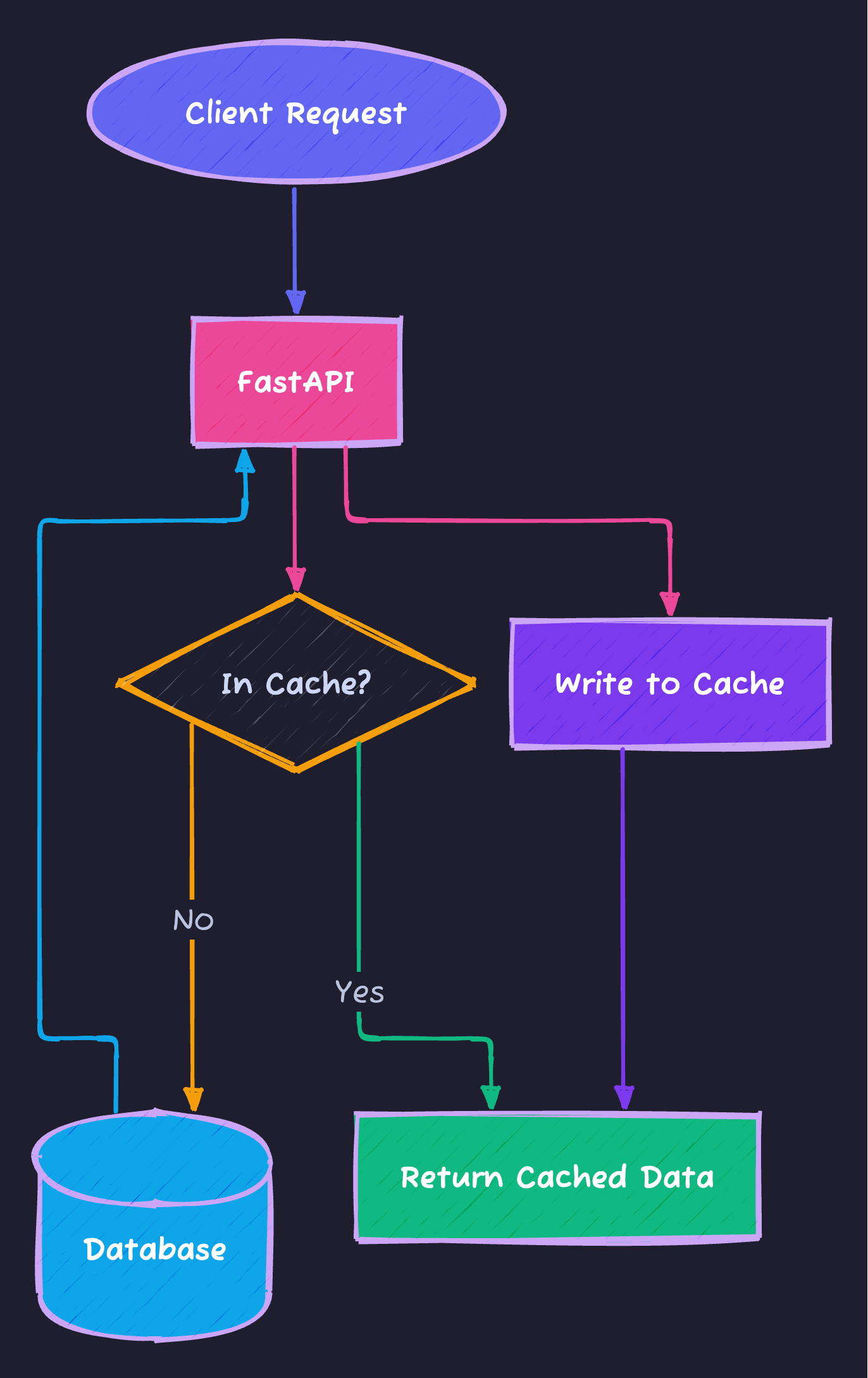
Decorator Implementation
Here is a reusable decorator that implements the logic above:
import redis
from functools import wraps
import json

# In production, use environment variables for host/port
redis_client = redis.Redis(host="localhost", port=6379, db=0)

def cache(ttl: int = 300):
    def decorator(func):
        @wraps(func)
        async def wrapper(*args, **kwargs):
            # Generate a unique key based on arguments
            key = f"{func.__name__}:{args}:{kwargs}"

            # 1. Check Cache
            cached = redis_client.get(key)
            if cached:
                return json.loads(cached)

            # 2. Miss? Call the actual function (DB call)
            result = await func(*args, **kwargs)

            # 3. Write to Cache with Expiration (TTL)
            redis_client.setex(key, ttl, json.dumps(result))
            return result
        return wrapper
    return decorator

@app.get("/products/{product_id}")
@cache(ttl=60)
async def get_product(product_id: int):
    # This slow DB call only runs if cache is empty
    return await fetch_product_from_db(product_id)
Cache Dependency
from fastapi import Depends
import aioredis

async def get_redis():
    redis = await aioredis.from_url("redis://localhost")
    try:
        yield redis
    finally:
        await redis.close()

@app.get("/data/{key}")
async def get_cached_data(key: str, redis = Depends(get_redis)):
    cached = await redis.get(key)
    if cached:
        return {"data": cached.decode(), "cached": True}

    data = await fetch_data(key)
    await redis.setex(key, 300, data)
    return {"data": data, "cached": False}
Database Optimization
The database is usually the bottleneck. Two strategies help here: Connection Pooling and Async Drivers.
Connection Pooling
Creating a new DB connection is expensive (TCP handshake, auth, etc.). A pool keeps a set of open connections ready for reuse.
from sqlalchemy import create_engine
from sqlalchemy.pool import QueuePool

engine = create_engine(
    DATABASE_URL,
    poolclass=QueuePool,
    pool_size=10,        # Keep 10 connections open
    max_overflow=20,     # Burst up to 30 total during load
    pool_pre_ping=True   # Check if connection is alive before using
)
Async Database
from sqlalchemy.ext.asyncio import create_async_engine, AsyncSession

engine = create_async_engine(
    "postgresql+asyncpg://user:pass@localhost/db",
    pool_size=10,
    max_overflow=20
)
Query Optimization
from sqlalchemy.orm import selectinload

# Eager loading to avoid N+1
@app.get("/users")
async def get_users(db: AsyncSession = Depends(get_db)):
    result = await db.execute(
        select(User).options(selectinload(User.posts))
    )
    return result.scalars().all()
Response Caching Headers
from fastapi import Response

@app.get("/static-data")
async def get_static_data(response: Response):
    response.headers["Cache-Control"] = "public, max-age=3600"
    return {"data": "static content"}
Async Best Practices
FastAPI is built on AnyIO and asyncio. To get maximum performance, your I/O-bound operations (DB calls, external APIs) must be non-blocking.
Blocking vs Non-Blocking I/O
sequenceDiagram
    participant Worker
    participant Ext as External API

    note right of Worker: Sync (Blocking)
    Worker->>Ext: Request 1
    Ext-->>Worker: Wait...
    Ext-->>Worker: Response 1
    Worker->>Ext: Request 2
    Ext-->>Worker: Response 2

    note right of Worker: Async (Concurrent)
    Worker->>Ext: Request 1
    Worker->>Ext: Request 2
    Ext-->>Worker: Response 1
    Ext-->>Worker: Response 2
Parallel Execution with asyncio.gather
If you need to call multiple independent APIs, run them in parallel:
import asyncio
import httpx

# Parallel external calls
@app.get("/dashboard")
async def get_dashboard():
    async with httpx.AsyncClient() as client:
        # Start all requests simultaneously
        tasks = [
            client.get("https://api1.com/data"),
            client.get("https://api2.com/data"),
            client.get("https://api3.com/data")
        ]

        # Wait for all to complete
        results = await asyncio.gather(*tasks)

    return {"data": [r.json() for r in results]}
Performance Monitoring
import time
from fastapi import Request

@app.middleware("http")
async def timing_middleware(request: Request, call_next):
    start = time.perf_counter()
    response = await call_next(request)
    duration = time.perf_counter() - start
    response.headers["X-Response-Time"] = f"{duration:.4f}s"
    return response
Summary
| Technique | Impact |
|---|---|
| Redis caching | Reduce DB load |
| Connection pooling | Efficient connections |
| Async operations | Better concurrency |
| Eager loading | Avoid N+1 queries |
Next Steps
In Part 18, we’ll explore API Security Best Practices - securing your FastAPI application.
Series Navigation:
- Part 1-16: Previous parts
- Part 17: Performance & Caching (You are here)
- Part 18: Security Best Practices
Advertisement
Moshiour Rahman
Software Architect & AI Engineer
Enterprise software architect with deep expertise in financial systems, distributed architecture, and AI-powered applications. Building large-scale systems at Fortune 500 companies. Specializing in LLM orchestration, multi-agent systems, and cloud-native solutions. I share battle-tested patterns from real enterprise projects.
Related Articles
FastAPI Tutorial Part 20: Building a Production-Ready API
Build a complete production-ready FastAPI application. Combine all concepts into a real-world e-commerce API with authentication, database, and deployment.
PythonFastAPI Tutorial Part 19: OpenAPI and API Documentation
Create professional API documentation with FastAPI. Learn OpenAPI customization, Swagger UI, ReDoc, and documentation best practices.
PythonFastAPI Tutorial Part 16: Docker and Deployment
Deploy FastAPI applications to production. Learn Docker containerization, Docker Compose, cloud deployment, and production best practices.
Comments
Comments are powered by GitHub Discussions.
Configure Giscus at giscus.app to enable comments.