Service Mesh with Istio: Complete Kubernetes Guide
Master Istio service mesh for Kubernetes. Learn traffic management, security, observability, and build resilient microservices architectures.
Moshiour Rahman
Advertisement
What is Istio?
Istio is a service mesh that provides traffic management, security, and observability for microservices. It handles cross-cutting concerns without changing application code.
Architecture Overview
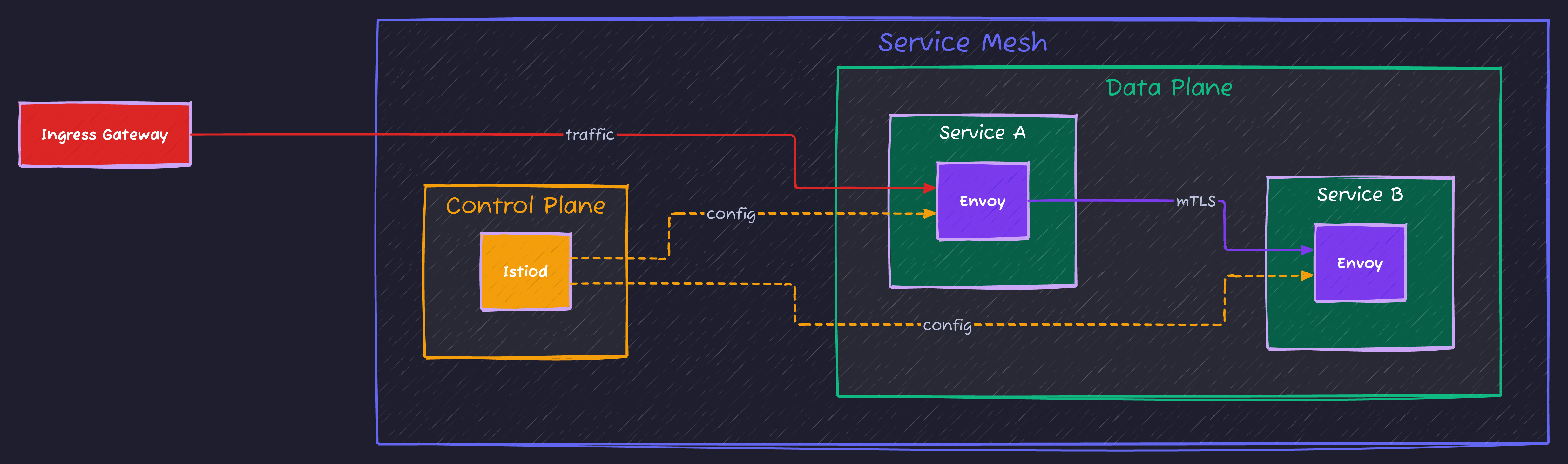
The Sidecar Pattern
Istio works by injecting a proxy (Envoy) next to every application container.
Service Mesh Benefits
| Feature | Description |
|---|---|
| Traffic Management | Routing, load balancing |
| Security | mTLS, authorization |
| Observability | Metrics, tracing |
| Resilience | Retries, circuit breakers |
Getting Started
Installation
# Download Istio
curl -L https://istio.io/downloadIstio | sh -
cd istio-*
export PATH=$PWD/bin:$PATH

# Install Istio
istioctl install --set profile=demo -y

# Enable sidecar injection
kubectl label namespace default istio-injection=enabled

# Verify installation
kubectl get pods -n istio-system
istioctl verify-install
Install Addons
# Prometheus, Grafana, Kiali, Jaeger
kubectl apply -f samples/addons

# Access dashboards
istioctl dashboard kiali
istioctl dashboard grafana
istioctl dashboard jaeger
Traffic Management
Virtual Services
apiVersion: networking.istio.io/v1beta1
kind: VirtualService
metadata:
  name: my-service
spec:
  hosts:
    - my-service
  http:
    - match:
        - headers:
            user-agent:
              prefix: "Mozilla"
      route:
        - destination:
            host: my-service
            subset: v2
    - route:
        - destination:
            host: my-service
            subset: v1
Destination Rules
apiVersion: networking.istio.io/v1beta1
kind: DestinationRule
metadata:
  name: my-service
spec:
  host: my-service
  trafficPolicy:
    connectionPool:
      tcp:
        maxConnections: 100
      http:
        h2UpgradePolicy: UPGRADE
        http1MaxPendingRequests: 100
        http2MaxRequests: 1000
    loadBalancer:
      simple: ROUND_ROBIN
  subsets:
    - name: v1
      labels:
        version: v1
    - name: v2
      labels:
        version: v2
      trafficPolicy:
        loadBalancer:
          simple: LEAST_CONN
Canary Deployments
We can split traffic between versions (e.g., 90% to stable, 10% to canary) without changing code.
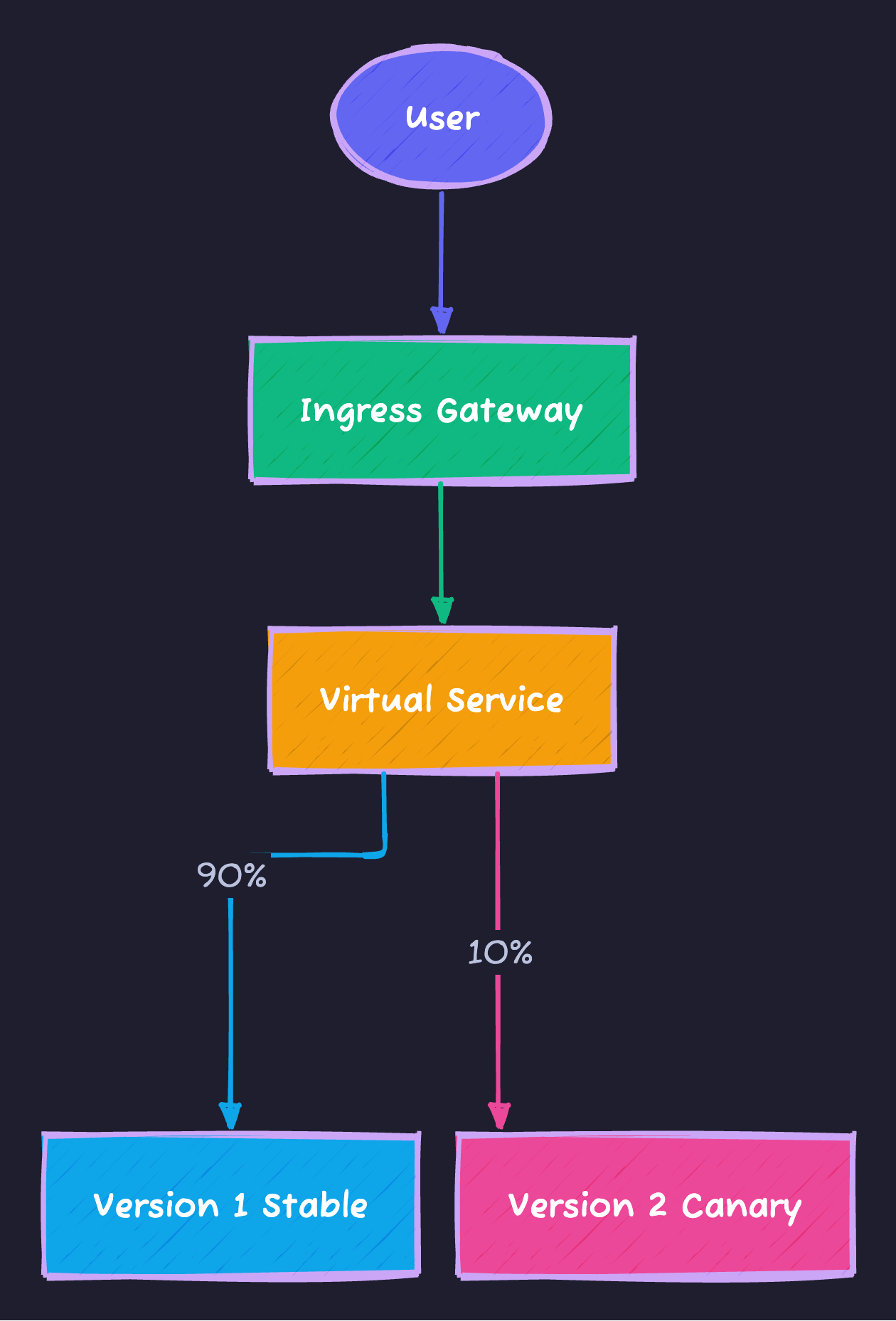
apiVersion: networking.istio.io/v1beta1
kind: VirtualService
metadata:
  name: my-service
spec:
  hosts:
    - my-service
  http:
    - route:
        - destination:
            host: my-service
            subset: v1
          weight: 90
        - destination:
            host: my-service
            subset: v2
          weight: 10
A/B Testing
apiVersion: networking.istio.io/v1beta1
kind: VirtualService
metadata:
  name: my-service
spec:
  hosts:
    - my-service
  http:
    - match:
        - headers:
            x-user-type:
              exact: "beta"
      route:
        - destination:
            host: my-service
            subset: v2
    - route:
        - destination:
            host: my-service
            subset: v1
Request Routing
apiVersion: networking.istio.io/v1beta1
kind: VirtualService
metadata:
  name: my-service
spec:
  hosts:
    - my-service
  http:
    # Route by URI
    - match:
        - uri:
            prefix: "/api/v2"
      route:
        - destination:
            host: my-service
            subset: v2

    # Route by header
    - match:
        - headers:
            end-user:
              exact: "jason"
      route:
        - destination:
            host: my-service
            subset: v2

    # Default route
    - route:
        - destination:
            host: my-service
            subset: v1
Resilience
Timeouts and Retries
apiVersion: networking.istio.io/v1beta1
kind: VirtualService
metadata:
  name: my-service
spec:
  hosts:
    - my-service
  http:
    - route:
        - destination:
            host: my-service
      timeout: 10s
      retries:
        attempts: 3
        perTryTimeout: 3s
        retryOn: gateway-error,connect-failure,refused-stream
Circuit Breaker
apiVersion: networking.istio.io/v1beta1
kind: DestinationRule
metadata:
  name: my-service
spec:
  host: my-service
  trafficPolicy:
    outlierDetection:
      consecutive5xxErrors: 5
      interval: 30s
      baseEjectionTime: 30s
      maxEjectionPercent: 100
      minHealthPercent: 0
Fault Injection
apiVersion: networking.istio.io/v1beta1
kind: VirtualService
metadata:
  name: my-service
spec:
  hosts:
    - my-service
  http:
    - fault:
        delay:
          percentage:
            value: 10
          fixedDelay: 5s
        abort:
          percentage:
            value: 5
          httpStatus: 500
      route:
        - destination:
            host: my-service
Rate Limiting
apiVersion: networking.istio.io/v1beta1
kind: EnvoyFilter
metadata:
  name: rate-limit
spec:
  workloadSelector:
    labels:
      app: my-service
  configPatches:
    - applyTo: HTTP_FILTER
      match:
        context: SIDECAR_INBOUND
        listener:
          filterChain:
            filter:
              name: envoy.filters.network.http_connection_manager
      patch:
        operation: INSERT_BEFORE
        value:
          name: envoy.filters.http.local_ratelimit
          typed_config:
            "@type": type.googleapis.com/udpa.type.v1.TypedStruct
            type_url: type.googleapis.com/envoy.extensions.filters.http.local_ratelimit.v3.LocalRateLimit
            value:
              stat_prefix: http_local_rate_limiter
              token_bucket:
                max_tokens: 100
                tokens_per_fill: 100
                fill_interval: 60s
              filter_enabled:
                runtime_key: local_rate_limit_enabled
                default_value:
                  numerator: 100
                  denominator: HUNDRED
Security
Mutual TLS
# Enable strict mTLS
apiVersion: security.istio.io/v1beta1
kind: PeerAuthentication
metadata:
  name: default
  namespace: istio-system
spec:
  mtls:
    mode: STRICT
# Permissive mode for specific namespace
apiVersion: security.istio.io/v1beta1
kind: PeerAuthentication
metadata:
name: default
namespace: legacy
spec:
mtls:
mode: PERMISSIVEAuthorization Policies
# Deny all by default
apiVersion: security.istio.io/v1beta1
kind: AuthorizationPolicy
metadata:
  name: deny-all
  namespace: default
spec:
  {}
# Allow specific access
apiVersion: security.istio.io/v1beta1
kind: AuthorizationPolicy
metadata:
name: allow-frontend
namespace: default
spec:
selector:
matchLabels:
app: backend
action: ALLOW
rules:
- from:
- source:
principals: ["cluster.local/ns/default/sa/frontend"]
to:
- operation:
methods: ["GET", "POST"]
paths: ["/api/*"]JWT Authentication
apiVersion: security.istio.io/v1beta1
kind: RequestAuthentication
metadata:
  name: jwt-auth
  namespace: default
spec:
  selector:
    matchLabels:
      app: my-service
  jwtRules:
    - issuer: "https://auth.example.com"
      jwksUri: "https://auth.example.com/.well-known/jwks.json"
      audiences:
        - "my-service"
forwardOriginalToken: trueapiVersion: security.istio.io/v1beta1
kind: AuthorizationPolicy
metadata:
name: require-jwt
namespace: default
spec:
selector:
matchLabels:
app: my-service
action: ALLOW
rules:
- from:
- source:
requestPrincipals: ["https://auth.example.com/*"]
when:
- key: request.auth.claims[groups]
values: ["admin"]Ingress Gateway
apiVersion: networking.istio.io/v1beta1
kind: Gateway
metadata:
  name: my-gateway
spec:
  selector:
    istio: ingressgateway
  servers:
    - port:
        number: 80
        name: http
        protocol: HTTP
      hosts:
        - "*.example.com"
    - port:
        number: 443
        name: https
        protocol: HTTPS
      tls:
        mode: SIMPLE
        credentialName: example-credential
      hosts:
- "*.example.com"apiVersion: networking.istio.io/v1beta1
kind: VirtualService
metadata:
name: my-service
spec:
hosts:
- "app.example.com"
gateways:
- my-gateway
http:
- match:
- uri:
prefix: "/api"
route:
- destination:
host: api-service
port:
number: 8080
- route:
- destination:
host: web-service
port:
number: 80Observability
Distributed Tracing
# Enable tracing
apiVersion: install.istio.io/v1alpha1
kind: IstioOperator
spec:
  meshConfig:
    enableTracing: true
    defaultConfig:
      tracing:
        sampling: 100.0
        zipkin:
          address: zipkin.istio-system:9411
Custom Metrics
apiVersion: telemetry.istio.io/v1alpha1
kind: Telemetry
metadata:
  name: namespace-metrics
  namespace: default
spec:
  metrics:
    - providers:
        - name: prometheus
      overrides:
        - match:
            metric: REQUEST_COUNT
          tagOverrides:
            response_code:
              operation: UPSERT
Access Logging
apiVersion: telemetry.istio.io/v1alpha1
kind: Telemetry
metadata:
  name: mesh-default
  namespace: istio-system
spec:
  accessLogging:
    - providers:
        - name: envoy
Debugging
# Check proxy status
istioctl proxy-status

# Analyze configuration
istioctl analyze

# Debug specific pod
istioctl proxy-config cluster <pod-name>
istioctl proxy-config route <pod-name>
istioctl proxy-config listener <pod-name>

# Check Envoy config
istioctl proxy-config dump <pod-name>

# View metrics
kubectl exec -it <pod-name> -c istio-proxy -- pilot-agent request GET stats
Summary
| Feature | Resource |
|---|---|
| Routing | VirtualService |
| Load Balancing | DestinationRule |
| Gateway | Gateway |
| mTLS | PeerAuthentication |
| Authorization | AuthorizationPolicy |
| Observability | Telemetry |
Istio provides comprehensive service mesh capabilities for securing and managing microservices on Kubernetes.
Advertisement
Moshiour Rahman
Software Architect & AI Engineer
Enterprise software architect with deep expertise in financial systems, distributed architecture, and AI-powered applications. Building large-scale systems at Fortune 500 companies. Specializing in LLM orchestration, multi-agent systems, and cloud-native solutions. I share battle-tested patterns from real enterprise projects.
Related Articles
Kubernetes Helm Charts: Package and Deploy Applications
Master Helm for Kubernetes deployments. Learn chart creation, templates, values, dependencies, and best practices for production applications.
DevOpsArgoCD: GitOps Continuous Delivery for Kubernetes
Master ArgoCD for Kubernetes deployments. Learn GitOps principles, application management, sync strategies, and automate your deployment pipeline.
DevOpsKubernetes for Beginners: Complete Guide to Container Orchestration
Learn Kubernetes from scratch. Understand pods, deployments, services, and how to deploy your first application to a Kubernetes cluster with practical examples.
Comments
Comments are powered by GitHub Discussions.
Configure Giscus at giscus.app to enable comments.