Kafka Message Ordering: Guarantee Sequence Across Partitions
Master Kafka message ordering with single partitions, external sequencing, idempotent producers, and time window buffering. Production patterns included.
Moshiour Rahman
Advertisement
The Problem: Your Messages Arrived Out of Order
You send events M1, M2, M3 to Kafka. Your consumer receives M1, M3, M2.
In a banking app, this means debiting before crediting. In an e-commerce system, shipping before payment. Order matters.
Kafka guarantees order within a partition, but not across partitions. Once you scale to multiple partitions for throughput, ordering breaks.
Quick Answer (TL;DR)
| Strategy | Throughput | Ordering | Use When |
|---|---|---|---|
| Single partition | Low | Perfect | Small volume, strict order required |
| Key-based routing | Medium | Per-key | Order matters per entity (user, order) |
| Idempotent producer | High | Within partition | Prevent duplicates + order |
| External sequencing | High | Global | Need global order across partitions |
// Key-based routing - orders for same user go to same partition
producer.send(new ProducerRecord<>(topic, order.getUserId(), order));

// Idempotent producer - prevents duplicate/reordering on retry
props.put(ProducerConfig.ENABLE_IDEMPOTENCE_CONFIG, "true");
Understanding Kafka’s Ordering Model
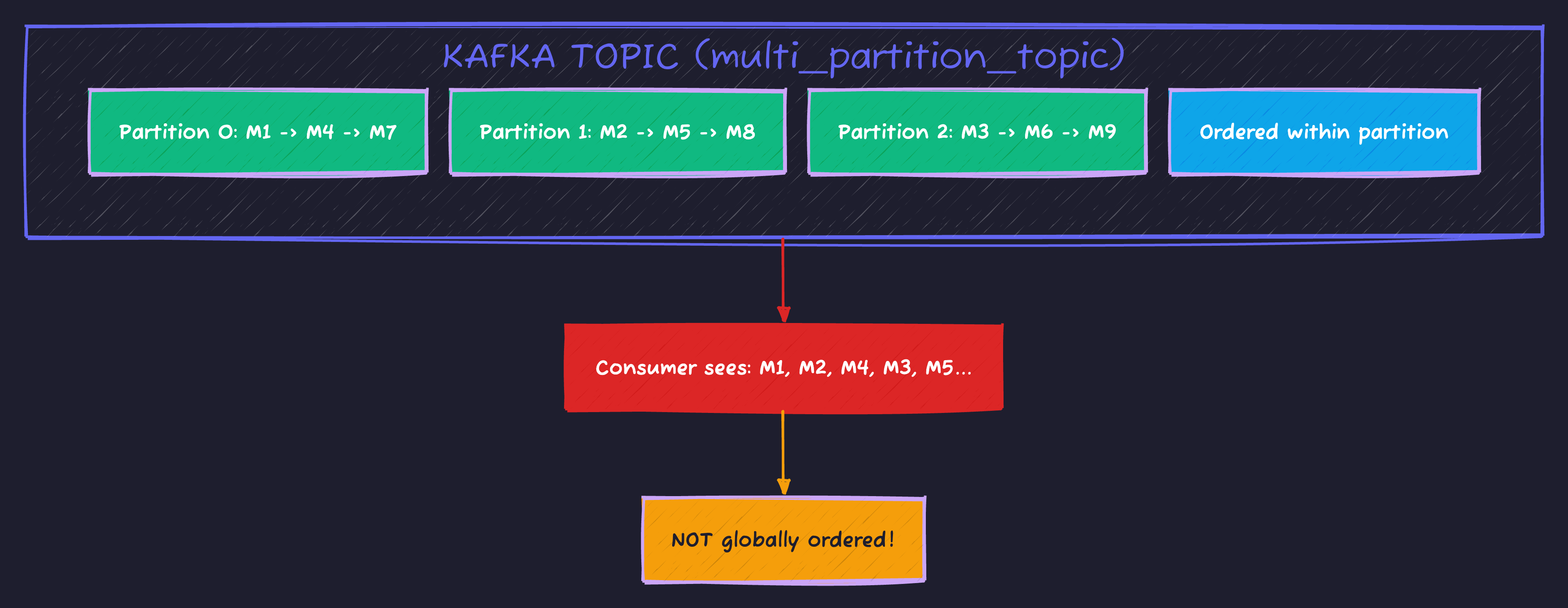
Why This Happens
- Producer sends M1, M2, M3 in sequence
- Partitioner routes each message to different partitions
- Consumer polls from all partitions - order depends on poll timing
- Result: M2 might arrive before M3 even though sent after
Strategy 1: Single Partition (Simplest)
Force all messages to one partition:
// Create topic with 1 partition
kafka-topics.sh --create --topic orders --partitions 1

// Producer - no key needed
producer.send(new ProducerRecord<>("orders", orderEvent));Pros: Perfect ordering Cons: Single consumer, limited throughput (~10K msg/sec typical)
Use for: Audit logs, compliance events, small-volume critical sequences
Strategy 2: Key-Based Routing (Most Common)
Route related messages to the same partition using a key:
// All events for user-123 go to the same partition
ProducerRecord<String, OrderEvent> record = new ProducerRecord<>(
    "orders",
    order.getUserId(),  // Key determines partition
    orderEvent
);
producer.send(record);
How It Works
Kafka uses consistent hashing on the message key to route to partitions:
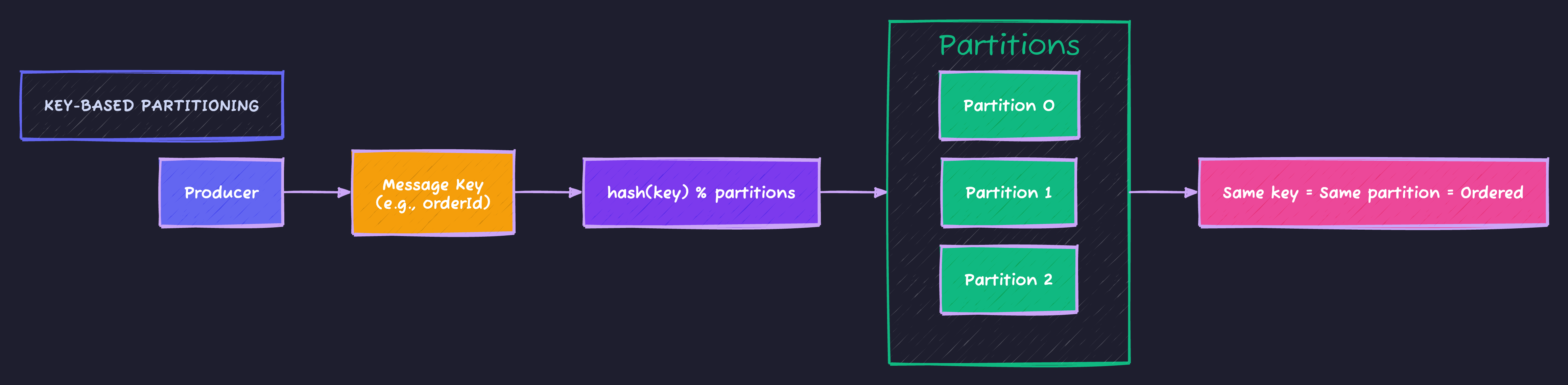
Same key always goes to the same partition = guaranteed order. Different keys go to different partitions = parallel processing.
Complete Example
@Service
public class OrderEventProducer {

    private final KafkaTemplate<String, OrderEvent> kafkaTemplate;

    public void sendOrderEvent(OrderEvent event) {
        // Key = orderId ensures all events for an order are ordered
        kafkaTemplate.send("order-events", event.getOrderId(), event);
    }
}

// Events sent in order:
// 1. ORDER_CREATED (order-123)
// 2. PAYMENT_RECEIVED (order-123)
// 3. ORDER_SHIPPED (order-123)
//
// Consumer receives in same order because same key → same partition
Strategy 3: Idempotent Producer (Prevent Duplicates)
Network failures can cause retries that duplicate or reorder messages. Idempotent producers fix this:
Properties props = new Properties();
props.put(ProducerConfig.BOOTSTRAP_SERVERS_CONFIG, "localhost:9092");
props.put(ProducerConfig.ENABLE_IDEMPOTENCE_CONFIG, "true");  // Key setting
props.put(ProducerConfig.ACKS_CONFIG, "all");
props.put(ProducerConfig.RETRIES_CONFIG, Integer.MAX_VALUE);
props.put(ProducerConfig.MAX_IN_FLIGHT_REQUESTS_PER_CONNECTION, 5);

KafkaProducer<String, String> producer = new KafkaProducer<>(props);
How Idempotence Works
Producer                    Broker
   │                           │
   │── Send M1 (seq=1) ──────▶│  ✓ Stored
   │                           │
   │── Send M2 (seq=2) ──────▶│  ✓ Stored
   │                           │
   │── Timeout (network)       │
   │                           │
   │── Retry M2 (seq=2) ─────▶│  ✗ Duplicate detected, ignored
   │                           │
   │◀── ACK ──────────────────│
Key settings:
| Config | Value | Purpose |
|---|---|---|
enable.idempotence | true | Enable dedup |
acks | all | Wait for all replicas |
max.in.flight.requests | ≤5 | Required for idempotence |
Strategy 4: External Sequencing (Global Order)
When you need order across ALL partitions (rare but sometimes necessary):
Producer: Add Sequence Number
public class SequencedProducer {

    private final AtomicLong sequenceGenerator = new AtomicLong(0);
    private final KafkaProducer<Long, Event> producer;

    public void send(Event event) {
        long seq = sequenceGenerator.incrementAndGet();
        event.setGlobalSequence(seq);
        event.setTimestamp(System.nanoTime());

        // Use sequence as key for consistent routing
        producer.send(new ProducerRecord<>("events", seq, event));
    }
}
Consumer: Buffer and Reorder
public class OrderedConsumer {

    private final List<Event> buffer = new ArrayList<>();
    private final Duration bufferWindow = Duration.ofMillis(500);
    private Instant lastProcessTime = Instant.now();

    public void poll() {
        ConsumerRecords<Long, Event> records = consumer.poll(Duration.ofMillis(100));

        for (ConsumerRecord<Long, Event> record : records) {
            buffer.add(record.value());
        }

        // Process buffer when window expires
        if (Duration.between(lastProcessTime, Instant.now()).compareTo(bufferWindow) > 0) {
            processBuffer();
            lastProcessTime = Instant.now();
        }
    }

    private void processBuffer() {
        // Sort by global sequence number
        buffer.sort(Comparator.comparingLong(Event::getGlobalSequence));

        for (Event event : buffer) {
            process(event);
        }
        buffer.clear();
    }
}
Trade-offs
| Aspect | Impact |
|---|---|
| Latency | Adds buffer window delay |
| Memory | Buffer grows with throughput |
| Complexity | State management required |
| Late arrivals | Messages after window missed |
Configuration Deep Dive
Producer Settings
Properties props = new Properties();

// Ordering guarantee: process one request at a time
props.put(ProducerConfig.MAX_IN_FLIGHT_REQUESTS_PER_CONNECTION, 1);

// Batching: balance latency vs throughput
props.put(ProducerConfig.BATCH_SIZE_CONFIG, 16384);  // 16KB batches
props.put(ProducerConfig.LINGER_MS_CONFIG, 5);       // Wait 5ms for batch

// Reliability
props.put(ProducerConfig.ACKS_CONFIG, "all");
props.put(ProducerConfig.ENABLE_IDEMPOTENCE_CONFIG, true);
Consumer Settings
Properties props = new Properties();

// Batch size: affects ordering complexity
props.put(ConsumerConfig.MAX_POLL_RECORDS_CONFIG, 500);

// Fetch settings
props.put(ConsumerConfig.FETCH_MIN_BYTES_CONFIG, 1);
props.put(ConsumerConfig.FETCH_MAX_WAIT_MS_CONFIG, 500);

// Offset management
props.put(ConsumerConfig.ENABLE_AUTO_COMMIT_CONFIG, false);  // Manual commit
props.put(ConsumerConfig.AUTO_OFFSET_RESET_CONFIG, "earliest");
Decision Framework
Use this flowchart to choose your ordering strategy:
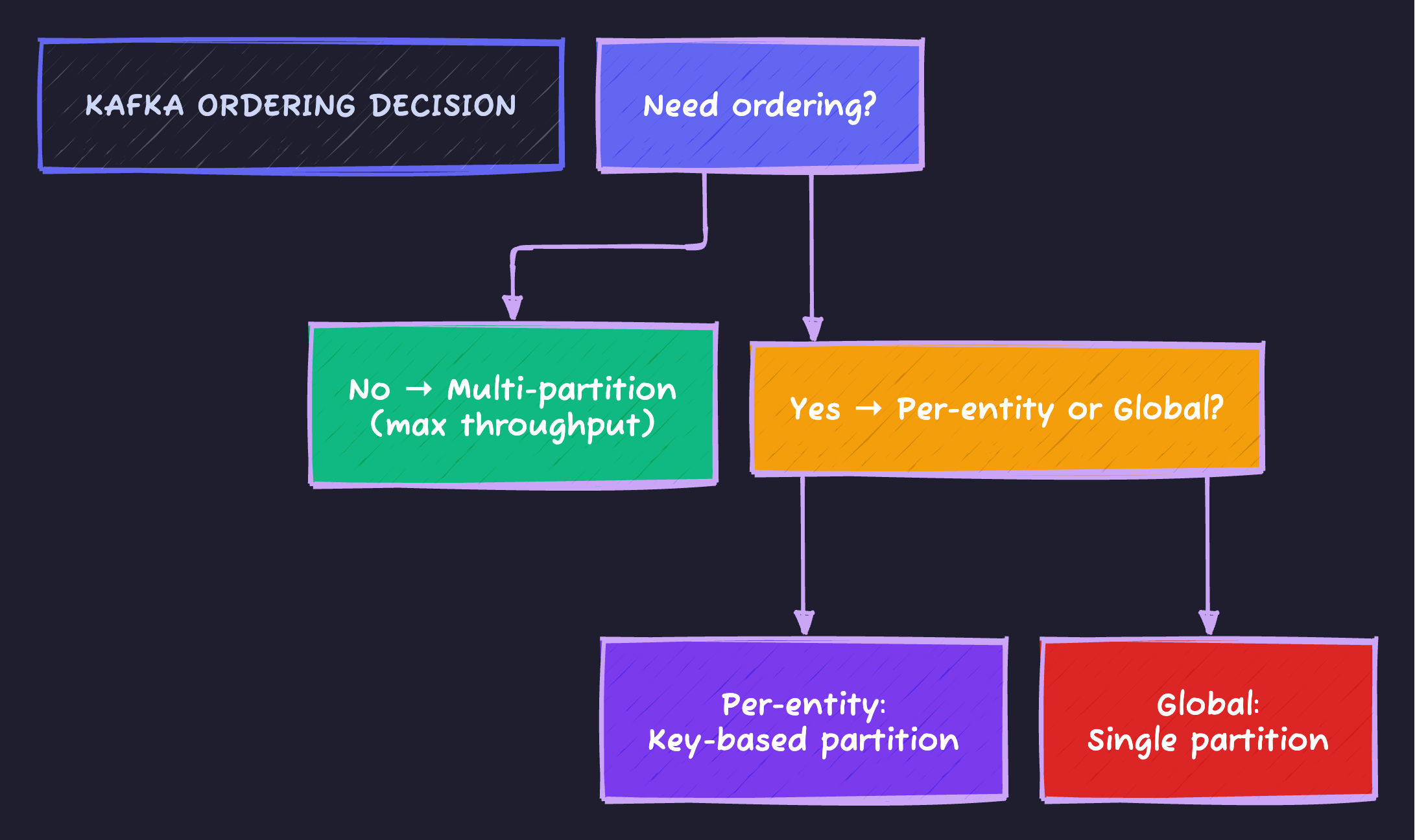
Most applications need per-entity ordering (same user, same order) which is solved with key-based partitioning. Global ordering requires a single partition, sacrificing parallelism.
Spring Kafka Example
@Configuration
public class KafkaConfig {

    @Bean
    public ProducerFactory<String, OrderEvent> producerFactory() {
        Map<String, Object> config = new HashMap<>();
        config.put(ProducerConfig.BOOTSTRAP_SERVERS_CONFIG, "localhost:9092");
        config.put(ProducerConfig.ENABLE_IDEMPOTENCE_CONFIG, true);
        config.put(ProducerConfig.ACKS_CONFIG, "all");
        config.put(ProducerConfig.KEY_SERIALIZER_CLASS_CONFIG, StringSerializer.class);
        config.put(ProducerConfig.VALUE_SERIALIZER_CLASS_CONFIG, JsonSerializer.class);
        return new DefaultKafkaProducerFactory<>(config);
    }

    @Bean
    public KafkaTemplate<String, OrderEvent> kafkaTemplate() {
        return new KafkaTemplate<>(producerFactory());
    }
}

@Service
public class OrderService {

    @Autowired
    private KafkaTemplate<String, OrderEvent> kafkaTemplate;

    public void processOrder(Order order) {
        // All events for same order go to same partition
        kafkaTemplate.send("orders", order.getId(),
            new OrderEvent(order.getId(), "CREATED", Instant.now()));
    }
}

@KafkaListener(topics = "orders", groupId = "order-processor")
public void handleOrderEvent(OrderEvent event) {
    // Events for same orderId arrive in order
    log.info("Processing: {} for order {}", event.getType(), event.getOrderId());
}
Common Pitfalls
| Pitfall | Symptom | Fix |
|---|---|---|
| No message key | Random partition assignment | Always set key for ordered entities |
max.in.flight > 1 without idempotence | Reordering on retry | Enable idempotence or set to 1 |
| Consumer rebalance | Processing restarts mid-sequence | Use sticky assignor, handle carefully |
| Key cardinality too low | Hot partitions | Use composite keys |
Code Repository
Complete examples with Testcontainers:
GitHub: techyowls/techyowls-io-blog-public/kafka-message-ordering
git clone https://github.com/techyowls/techyowls-io-blog-public.git
cd techyowls-io-blog-public/kafka-message-ordering
./mvnw test  # Runs ordering tests with Testcontainers
Further Reading
- Spring AI MCP Guide - Event-driven AI
- Java 21 Virtual Threads - Scale Kafka consumers
- Kafka Documentation
Build event-driven systems that don’t lose order. Follow TechyOwls for more practical guides.
Advertisement
Moshiour Rahman
Software Architect & AI Engineer
Enterprise software architect with deep expertise in financial systems, distributed architecture, and AI-powered applications. Building large-scale systems at Fortune 500 companies. Specializing in LLM orchestration, multi-agent systems, and cloud-native solutions. I share battle-tested patterns from real enterprise projects.
Related Articles
Apache Kafka: Event Streaming for Modern Applications
Master Apache Kafka for event-driven architectures. Learn producers, consumers, topics, partitions, Kafka Streams, and build scalable data pipelines.
System DesignCAP Theorem Explained: The Distributed Systems Trade-Off Every Engineer Must Know
Master the CAP theorem for system design interviews. Understand Consistency, Availability, Partition Tolerance trade-offs with real database examples like MongoDB, Cassandra, DynamoDB.
System DesignMicroservices Design Patterns: Complete Architecture Guide
Master microservices architecture patterns. Learn service discovery, circuit breakers, saga pattern, API gateway, and build resilient distributed systems.
Comments
Comments are powered by GitHub Discussions.
Configure Giscus at giscus.app to enable comments.