Turborepo Advanced Patterns: Production-Ready Monorepo Architecture in 2025
Master production Turborepo patterns with real-world examples. Migration guide, CI/CD pipelines, remote caching, testing strategies, and framework-specific configs.
Moshiour Rahman
Advertisement
Building a production monorepo requires more than just create-turbo. This guide covers battle-tested patterns from real SaaS projects, including migration strategies, advanced caching, CI/CD optimization, and framework-specific configurations.
What This Guide Covers
| Section | What You’ll Learn |
|---|---|
| Architecture Patterns | Real project structures used in production |
| Migration Guide | Step-by-step polyrepo to monorepo |
| Advanced Caching | Self-hosted S3, cache optimization |
| CI/CD Patterns | GitHub Actions with matrix builds |
| Testing Strategies | Shared configs, coverage aggregation |
| Framework Configs | Next.js, Remix, React Native, Electron |
| Troubleshooting | Common issues and solutions |
Production Architecture Patterns
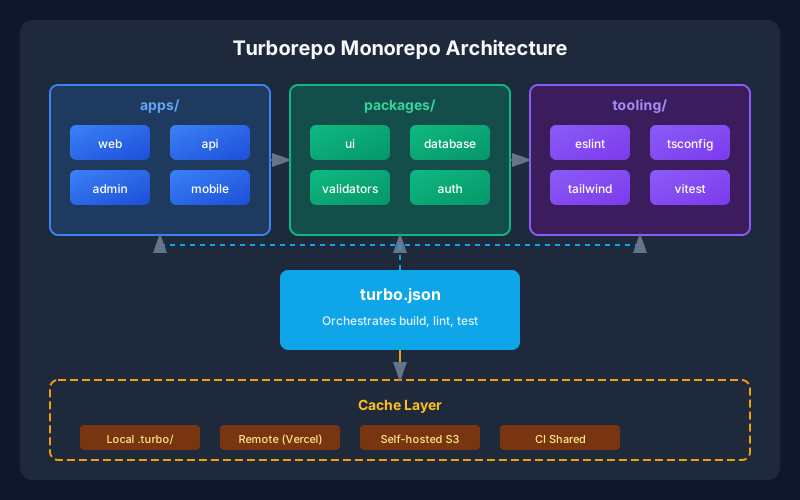
The SaaS Monorepo Structure
Here’s a battle-tested structure for a multi-product SaaS:
my-saas/
├── apps/
│   ├── web/                 # Next.js marketing + app
│   ├── api/                 # Hono/Express API server
│   ├── admin/               # Admin dashboard
│   ├── docs/                # Astro documentation
│   └── mobile/              # React Native app
├── packages/
│   ├── ui/                  # Shared React components
│   ├── database/            # Prisma/Drizzle + migrations
│   ├── auth/                # Shared auth (Clerk/Auth.js)
│   ├── email/               # React Email templates
│   ├── analytics/           # Tracking abstraction
│   ├── validators/          # Zod schemas (shared API contracts)
│   └── config/              # Environment & constants
├── tooling/
│   ├── eslint/              # Shared ESLint configs
│   ├── typescript/          # Base tsconfigs
│   ├── tailwind/            # Tailwind preset
│   └── prettier/            # Prettier config
├── turbo.json
├── pnpm-workspace.yaml
├── package.json
└── .github/
    └── workflows/
        ├── ci.yml
        └── deploy.yml
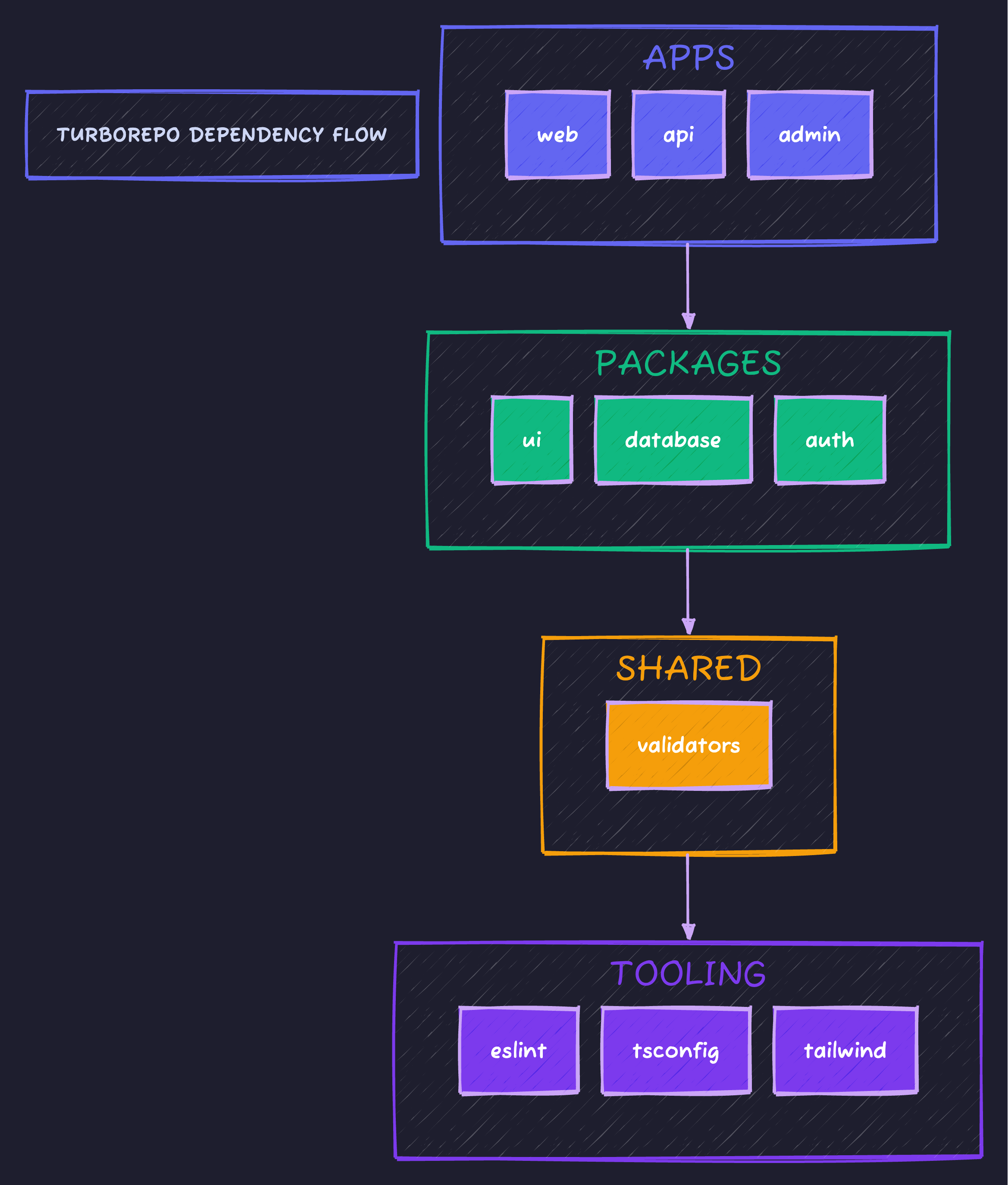
Dependency Graph Visualization
Understanding your dependency graph is critical for optimization:
Root Configuration Files
turbo.json - Production configuration:
{
  "$schema": "https://turbo.build/schema.json",
  "globalDependencies": [
    ".env",
    ".env.local",
    ".env.production"
  ],
  "globalEnv": [
    "NODE_ENV",
    "CI",
    "VERCEL"
  ],
  "tasks": {
    "build": {
      "dependsOn": ["^build"],
      "inputs": [
        "$TURBO_DEFAULT$",
        ".env",
        ".env.local",
        ".env.production"
      ],
      "outputs": [
        "dist/**",
        ".next/**",
        "!.next/cache/**",
        "build/**"
      ]
    },
    "lint": {
      "dependsOn": ["^lint"],
      "inputs": ["$TURBO_DEFAULT$"],
      "outputs": []
    },
    "typecheck": {
      "dependsOn": ["^typecheck"],
      "inputs": ["$TURBO_DEFAULT$"],
      "outputs": []
    },
    "test": {
      "dependsOn": ["^build"],
      "inputs": [
        "src/**",
        "tests/**",
        "vitest.config.*",
        "jest.config.*"
      ],
      "outputs": ["coverage/**"]
    },
    "test:e2e": {
      "dependsOn": ["^build"],
      "inputs": ["e2e/**", "playwright.config.*"],
      "outputs": ["playwright-report/**"]
    },
    "dev": {
      "cache": false,
      "persistent": true
    },
    "clean": {
      "cache": false
    },
    "db:generate": {
      "cache": false
    },
    "db:push": {
      "cache": false
    }
  }
}
pnpm-workspace.yaml with catalogs (pnpm 9+):
packages:
  - 'apps/*'
  - 'packages/*'
  - 'tooling/*'

# Centralized dependency versions (pnpm 9+)
catalog:
  # React ecosystem
  react: ^19.0.0
  react-dom: ^19.0.0
  next: ^15.1.0

  # Validation
  zod: ^3.24.0

  # Database
  drizzle-orm: ^0.38.0

  # Development
  typescript: ^5.7.0
  vitest: ^2.1.0

  # Styling
  tailwindcss: ^4.0.0
Root package.json:
{
  "name": "my-saas",
  "private": true,
  "scripts": {
    "build": "turbo run build",
    "dev": "turbo run dev",
    "lint": "turbo run lint",
    "typecheck": "turbo run typecheck",
    "test": "turbo run test",
    "test:e2e": "turbo run test:e2e",
    "clean": "turbo run clean && rm -rf node_modules .turbo",
    "format": "prettier --write \"**/*.{ts,tsx,md,json}\"",
    "db:generate": "turbo run db:generate",
    "db:push": "turbo run db:push"
  },
  "devDependencies": {
    "prettier": "^3.4.0",
    "turbo": "^2.3.0"
  },
  "packageManager": "pnpm@9.15.0",
  "engines": {
    "node": ">=20.0.0",
    "pnpm": ">=9.0.0"
  }
}
Migration: Polyrepo to Monorepo
Migration Strategy Overview
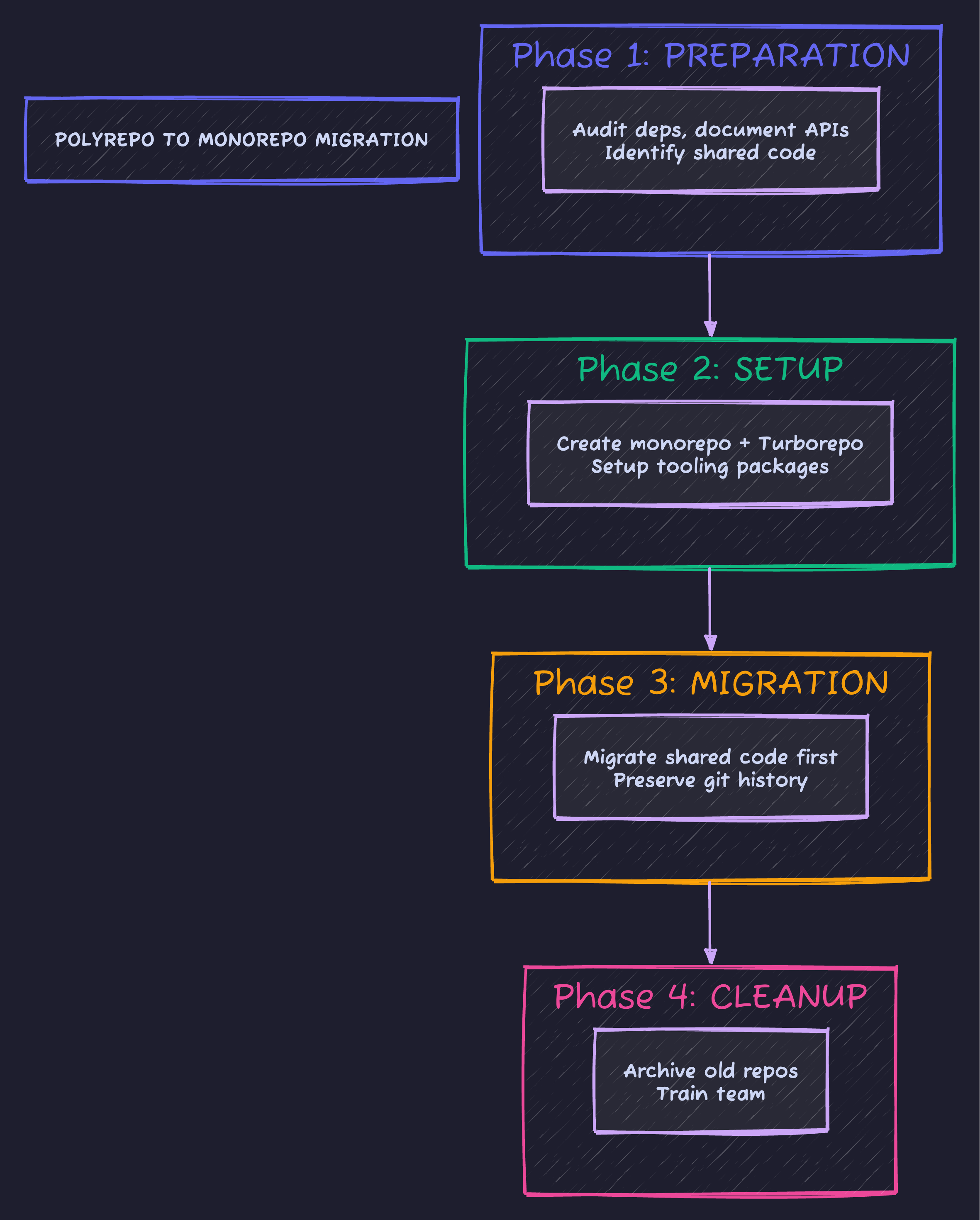
Step-by-Step Migration
Step 1: Create the monorepo foundation
# Create new monorepo
mkdir my-saas && cd my-saas
pnpm init

# Install Turborepo
pnpm add -D turbo

# Create directory structure
mkdir -p apps packages tooling .github/workflows

# Initialize git
git init
Step 2: Migrate with git history preserved
# Add existing repo as remote
git remote add frontend-repo git@github.com:org/frontend.git
git fetch frontend-repo

# Merge into apps/web with history
git merge frontend-repo/main --allow-unrelated-histories \
  -X subtree=apps/web \
  -m "chore: migrate frontend to monorepo"

# Repeat for other repos
git remote add api-repo git@github.com:org/api.git
git fetch api-repo
git merge api-repo/main --allow-unrelated-histories \
  -X subtree=apps/api \
  -m "chore: migrate api to monorepo"
Step 3: Extract shared code
# Create shared packages
mkdir -p packages/ui/src
mkdir -p packages/validators/src
mkdir -p packages/config/src

# Move shared code from apps to packages
# Example: UI components
mv apps/web/src/components/shared/* packages/ui/src/
Step 4: Update package.json files
// apps/web/package.json
{
  "name": "@myorg/web",
  "dependencies": {
    // Use workspace protocol for internal deps
    "@myorg/ui": "workspace:*",
    "@myorg/validators": "workspace:*",
    "@myorg/config": "workspace:*",
    // External deps use catalog
    "react": "catalog:",
    "next": "catalog:"
  }
}
Step 5: Fix import paths
// Before (direct file import)
import { Button } from '../../../shared/components/Button';
import { userSchema } from '../../../shared/validators';

// After (package import)
import { Button } from '@myorg/ui';
import { userSchema } from '@myorg/validators';
Migration Checklist
| Task | Status | Notes |
|---|---|---|
| Audit existing dependencies | ☐ | List all unique deps across repos |
| Identify shared code | ☐ | UI, validators, utilities |
| Create monorepo structure | ☐ | apps/, packages/, tooling/ |
| Setup tooling packages | ☐ | ESLint, TypeScript, Prettier |
| Migrate first app with history | ☐ | Usually the frontend |
| Extract shared packages | ☐ | Create packages from shared code |
| Update all imports | ☐ | Replace relative with package imports |
| Configure CI/CD | ☐ | Test build + deploy pipeline |
| Test all apps locally | ☐ | Run dev, build, test |
| Archive old repos | ☐ | Mark as deprecated/archived |
Advanced Caching Strategies
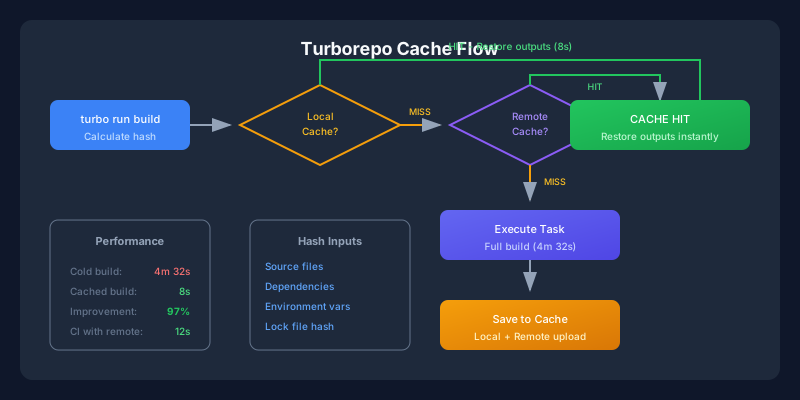
Understanding Cache Behavior
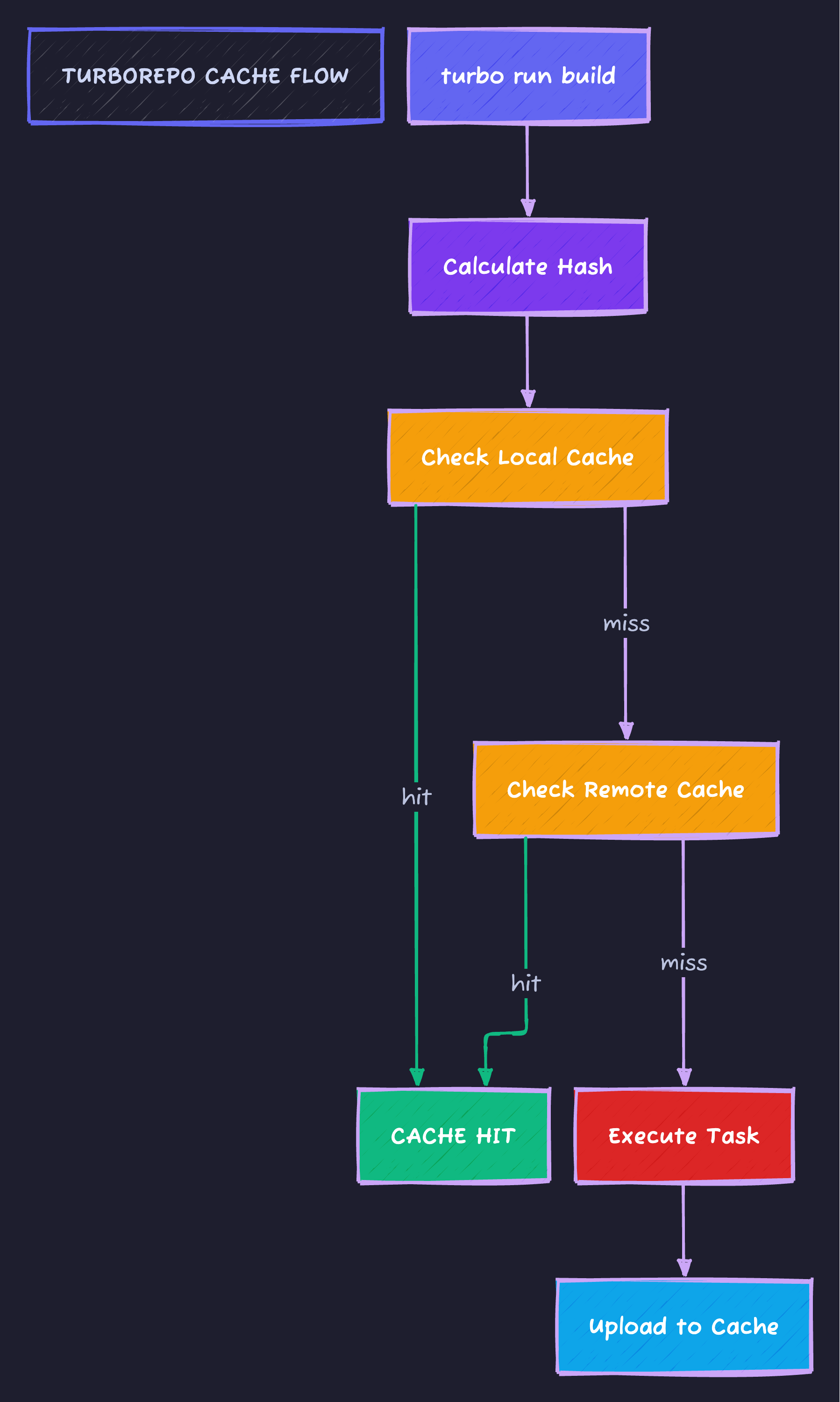
Self-Hosted Remote Cache with S3
Option 1: Using turborepo-remote-cache (Node.js)
// cache-server/src/index.ts
import { createServer } from '@vercel/turbo-remote-cache-server';
import { S3Client } from '@aws-sdk/client-s3';

const s3Client = new S3Client({
  region: process.env.AWS_REGION || 'us-east-1',
  credentials: {
    accessKeyId: process.env.AWS_ACCESS_KEY_ID!,
    secretAccessKey: process.env.AWS_SECRET_ACCESS_KEY!,
  },
});

const server = createServer({
  storage: {
    type: 's3',
    bucket: process.env.TURBO_CACHE_BUCKET!,
    client: s3Client,
  },
  auth: {
    type: 'bearer',
    // Generate secure tokens for CI/team
    tokens: process.env.TURBO_TOKENS!.split(','),
  },
});

server.listen(3001, () => {
  console.log('Turbo cache server running on :3001');
});
Option 2: Using Cloudflare R2 (cheaper)
# R2 is S3-compatible and much cheaper for cache
# Set these in CI environment
export TURBO_API="https://your-cache.workers.dev"
export TURBO_TOKEN="your-token"
export TURBO_TEAM="your-team"
// cache-worker/src/index.ts (Cloudflare Worker)
export default {
async fetch(request: Request, env: Env): Promise<Response> {
const url = new URL(request.url);
const path = url.pathname;
// Verify token
const token = request.headers.get('Authorization')?.replace('Bearer ', '');
if (token !== env.TURBO_TOKEN) {
return new Response('Unauthorized', { status: 401 });
}
// Handle cache operations
if (request.method === 'GET' && path.startsWith('/v8/artifacts/')) {
const key = path.replace('/v8/artifacts/', '');
const object = await env.TURBO_CACHE.get(key);
if (!object) return new Response('Not found', { status: 404 });
return new Response(object.body);
}
if (request.method === 'PUT' && path.startsWith('/v8/artifacts/')) {
const key = path.replace('/v8/artifacts/', '');
await env.TURBO_CACHE.put(key, request.body);
return new Response('OK');
}
return new Response('Not found', { status: 404 });
},
};Cache Optimization Tips
// turbo.json - Optimized caching
{
  "tasks": {
    "build": {
      "dependsOn": ["^build"],
      "inputs": [
        // Only include files that affect build
        "src/**/*.{ts,tsx,js,jsx}",
        "package.json",
        "tsconfig.json",
        // Exclude test files from build inputs
        "!src/**/*.test.ts",
        "!src/**/*.spec.ts",
        "!**/__tests__/**"
      ],
      "outputs": ["dist/**"]
    },
    "lint": {
      // Lint rarely needs to depend on built deps
      "dependsOn": [],
      "inputs": [
        "src/**/*.{ts,tsx}",
        ".eslintrc.*",
        "eslint.config.*"
      ],
      // Lint has no outputs (faster cache check)
      "outputs": []
    },
    "typecheck": {
      // Typecheck needs built declaration files
      "dependsOn": ["^build"],
      "inputs": [
        "src/**/*.{ts,tsx}",
        "tsconfig.json"
      ],
      "outputs": []
    }
  }
}
Cache Hit Rate Monitoring
# Check cache statistics
turbo run build --summarize

# Output shows cache hit/miss per package
# Tasks:    12 successful, 12 total
# Cached:   10 cached, 2 total (83% hit rate)
# Time:     2.3s (saved 4m 12s)
CI/CD Production Patterns
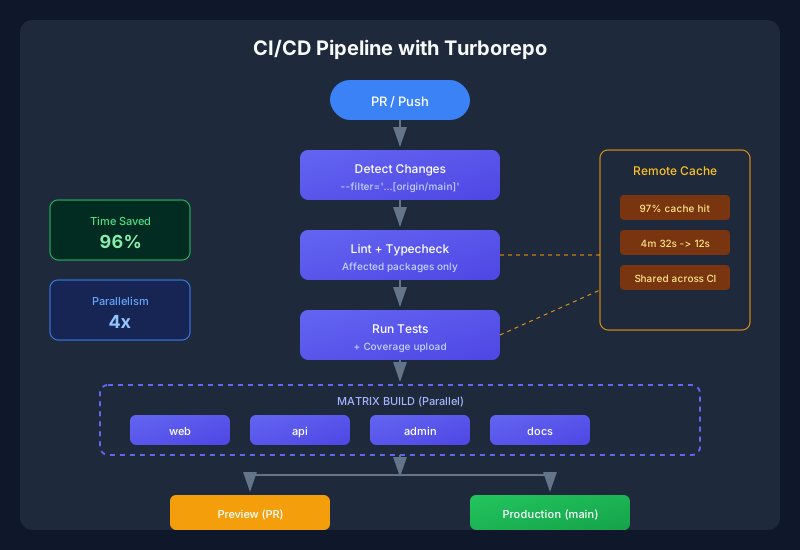
GitHub Actions: Full Pipeline
# .github/workflows/ci.yml
name: CI

on:
  push:
    branches: [main]
  pull_request:
    branches: [main]

# Cancel in-progress runs for same PR
concurrency:
  group: ${{ github.workflow }}-${{ github.ref }}
  cancel-in-progress: true

env:
  TURBO_TOKEN: ${{ secrets.TURBO_TOKEN }}
  TURBO_TEAM: ${{ vars.TURBO_TEAM }}
  TURBO_REMOTE_ONLY: true

jobs:
  # Determine affected packages for matrix
  changes:
    runs-on: ubuntu-latest
    outputs:
      packages: ${{ steps.filter.outputs.changes }}
    steps:
      - uses: actions/checkout@v4
        with:
          fetch-depth: 0

      - id: filter
        uses: dorny/paths-filter@v3
        with:
          filters: |
            web:
              - 'apps/web/**'
              - 'packages/ui/**'
              - 'packages/validators/**'
            api:
              - 'apps/api/**'
              - 'packages/database/**'
              - 'packages/validators/**'
            admin:
              - 'apps/admin/**'
              - 'packages/ui/**'

  lint-and-typecheck:
    runs-on: ubuntu-latest
    steps:
      - uses: actions/checkout@v4

      - uses: pnpm/action-setup@v4

      - uses: actions/setup-node@v4
        with:
          node-version: 22
          cache: 'pnpm'

      - run: pnpm install --frozen-lockfile

      - name: Lint
        run: pnpm turbo run lint --filter='...[origin/main]'

      - name: Type Check
        run: pnpm turbo run typecheck --filter='...[origin/main]'

  test:
    runs-on: ubuntu-latest
    needs: lint-and-typecheck
    steps:
      - uses: actions/checkout@v4

      - uses: pnpm/action-setup@v4

      - uses: actions/setup-node@v4
        with:
          node-version: 22
          cache: 'pnpm'

      - run: pnpm install --frozen-lockfile

      - name: Run Tests
        run: pnpm turbo run test --filter='...[origin/main]'

      - name: Upload Coverage
        uses: codecov/codecov-action@v4
        with:
          files: ./packages/*/coverage/lcov.info,./apps/*/coverage/lcov.info
          flags: unittests

  build:
    runs-on: ubuntu-latest
    needs: test
    strategy:
      matrix:
        app: [web, api, admin]
    steps:
      - uses: actions/checkout@v4

      - uses: pnpm/action-setup@v4

      - uses: actions/setup-node@v4
        with:
          node-version: 22
          cache: 'pnpm'

      - run: pnpm install --frozen-lockfile

      - name: Build ${{ matrix.app }}
        run: pnpm turbo run build --filter=${{ matrix.app }}...

      - name: Upload Build Artifact
        uses: actions/upload-artifact@v4
        with:
          name: ${{ matrix.app }}-build
          path: apps/${{ matrix.app }}/dist
          retention-days: 1

  e2e:
    runs-on: ubuntu-latest
    needs: build
    steps:
      - uses: actions/checkout@v4

      - uses: pnpm/action-setup@v4

      - uses: actions/setup-node@v4
        with:
          node-version: 22
          cache: 'pnpm'

      - run: pnpm install --frozen-lockfile

      - name: Install Playwright
        run: pnpm exec playwright install --with-deps chromium

      - name: Download web build
        uses: actions/download-artifact@v4
        with:
          name: web-build
          path: apps/web/dist

      - name: Run E2E Tests
        run: pnpm turbo run test:e2e --filter=web

      - uses: actions/upload-artifact@v4
        if: failure()
        with:
          name: playwright-report
          path: apps/web/playwright-report/

  deploy-preview:
    if: github.event_name == 'pull_request'
    runs-on: ubuntu-latest
    needs: [build, e2e]
    steps:
      - uses: actions/checkout@v4

      - uses: actions/download-artifact@v4
        with:
          name: web-build
          path: apps/web/dist

      - name: Deploy to Vercel Preview
        uses: amondnet/vercel-action@v25
        with:
          vercel-token: ${{ secrets.VERCEL_TOKEN }}
          vercel-org-id: ${{ secrets.VERCEL_ORG_ID }}
          vercel-project-id: ${{ secrets.VERCEL_PROJECT_ID }}
          working-directory: apps/web

  deploy-production:
    if: github.ref == 'refs/heads/main' && github.event_name == 'push'
    runs-on: ubuntu-latest
    needs: [build, e2e]
    environment: production
    steps:
      - uses: actions/checkout@v4

      - uses: actions/download-artifact@v4
        with:
          name: web-build
          path: apps/web/dist

      - name: Deploy to Vercel Production
        uses: amondnet/vercel-action@v25
        with:
          vercel-token: ${{ secrets.VERCEL_TOKEN }}
          vercel-org-id: ${{ secrets.VERCEL_ORG_ID }}
          vercel-project-id: ${{ secrets.VERCEL_PROJECT_ID }}
          vercel-args: '--prod'
          working-directory: apps/web
CI Pipeline Visualization
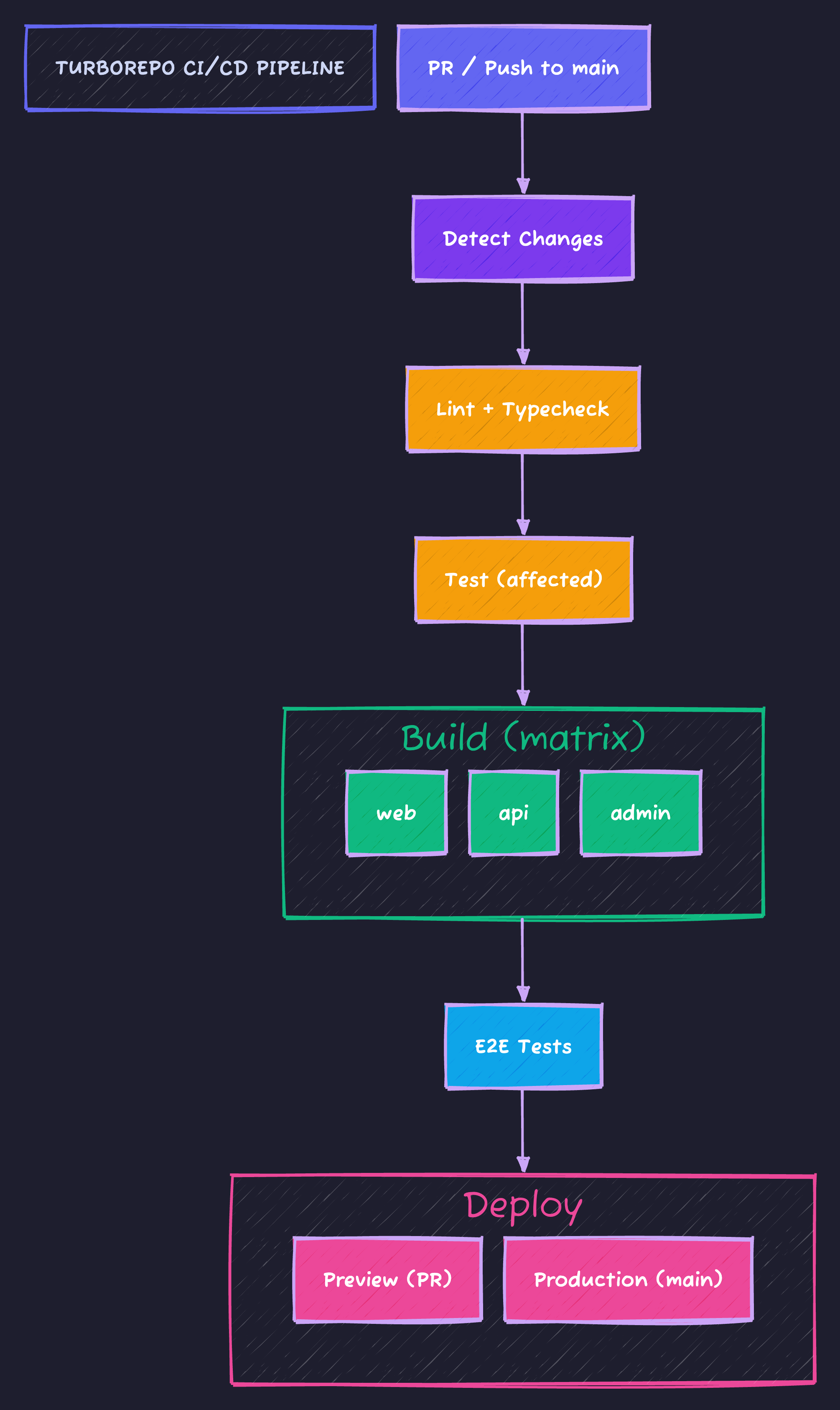
Testing Strategies
Shared Test Configuration
tooling/vitest/base.ts:
import { defineConfig } from 'vitest/config';

export const baseConfig = defineConfig({
  test: {
    globals: true,
    environment: 'node',
    coverage: {
      provider: 'v8',
      reporter: ['text', 'lcov', 'html'],
      exclude: [
        'node_modules/**',
        'dist/**',
        '**/*.d.ts',
        '**/*.config.*',
        '**/index.ts', // Re-exports only
      ],
    },
    include: ['src/**/*.{test,spec}.{ts,tsx}'],
    passWithNoTests: true,
  },
});tooling/vitest/react.ts:
import { defineConfig, mergeConfig } from 'vitest/config';
import react from '@vitejs/plugin-react';
import { baseConfig } from './base';

export const reactConfig = mergeConfig(
  baseConfig,
  defineConfig({
    plugins: [react()],
    test: {
      environment: 'jsdom',
      setupFiles: ['./test/setup.ts'],
    },
  })
);packages/ui/vitest.config.ts:
import { reactConfig } from '@myorg/vitest-config/react';

export default reactConfig;
Test Structure Per Package
packages/ui/
├── src/
│   ├── Button/
│   │   ├── Button.tsx
│   │   ├── Button.test.tsx      # Unit test
│   │   └── index.ts
│   └── index.ts
├── test/
│   └── setup.ts                  # Test setup
├── vitest.config.ts
└── package.jsonpackages/ui/test/setup.ts:
import '@testing-library/jest-dom/vitest';
import { cleanup } from '@testing-library/react';
import { afterEach } from 'vitest';

afterEach(() => {
  cleanup();
});
E2E Testing with Playwright
apps/web/playwright.config.ts:
import { defineConfig, devices } from '@playwright/test';

export default defineConfig({
  testDir: './e2e',
  fullyParallel: true,
  forbidOnly: !!process.env.CI,
  retries: process.env.CI ? 2 : 0,
  workers: process.env.CI ? 1 : undefined,
  reporter: [
    ['html'],
    ['github'],
  ],
  use: {
    baseURL: process.env.PLAYWRIGHT_TEST_BASE_URL || 'http://localhost:3000',
    trace: 'on-first-retry',
    screenshot: 'only-on-failure',
  },
  projects: [
    {
      name: 'chromium',
      use: { ...devices['Desktop Chrome'] },
    },
    {
      name: 'mobile',
      use: { ...devices['iPhone 14'] },
    },
  ],
  webServer: process.env.CI ? undefined : {
    command: 'pnpm run dev',
    url: 'http://localhost:3000',
    reuseExistingServer: !process.env.CI,
  },
});
Coverage Aggregation
scripts/coverage-report.ts:
import { execSync } from 'child_process';
import { readdirSync, existsSync } from 'fs';
import { join } from 'path';

const packages = [
  ...readdirSync('packages').map(p => `packages/${p}`),
  ...readdirSync('apps').map(a => `apps/${a}`),
];

const coverageFiles = packages
  .map(p => join(p, 'coverage/lcov.info'))
  .filter(existsSync);

if (coverageFiles.length > 0) {
  // Merge coverage reports
  execSync(`npx lcov-result-merger '*/coverage/lcov.info' merged-coverage.info`);

  // Generate HTML report
  execSync(`npx genhtml merged-coverage.info -o coverage-report`);

  console.log('Coverage report generated at coverage-report/index.html');
}
Framework-Specific Configurations
Next.js 15 App Router
apps/web/next.config.ts:
import type { NextConfig } from 'next';

const config: NextConfig = {
  // Enable standalone output for Docker
  output: 'standalone',

  // Transpile internal packages
  transpilePackages: [
    '@myorg/ui',
    '@myorg/validators',
    '@myorg/config',
  ],

  // Experimental features
  experimental: {
    // Enable React 19 features
    reactCompiler: true,
    // Optimize package imports
    optimizePackageImports: [
      '@myorg/ui',
      'lucide-react',
    ],
  },

  // Configure for monorepo
  webpack: (config, { isServer }) => {
    // Handle workspace packages
    if (!isServer) {
      config.resolve.fallback = {
        ...config.resolve.fallback,
        fs: false,
      };
    }
    return config;
  },
};

export default config;
Hono API Server
apps/api/src/index.ts:
import { serve } from '@hono/node-server';
import { Hono } from 'hono';
import { cors } from 'hono/cors';
import { logger } from 'hono/logger';
import { db } from '@myorg/database';
import { userRouter } from './routes/user';

const app = new Hono();

// Middleware
app.use('*', logger());
app.use('*', cors({
  origin: process.env.CORS_ORIGIN?.split(',') || ['http://localhost:3000'],
}));

// Health check
app.get('/health', (c) => c.json({ status: 'ok' }));

// Routes
app.route('/api/users', userRouter);

// Start server
const port = parseInt(process.env.PORT || '4000');
serve({ fetch: app.fetch, port });
console.log(`API running on http://localhost:${port}`);apps/api/tsconfig.json:
{
  "extends": "@myorg/typescript-config/node.json",
  "compilerOptions": {
    "outDir": "dist",
    "rootDir": "src"
  },
  "include": ["src"],
  "exclude": ["node_modules", "dist"]
}
React Native
apps/mobile/metro.config.js:
const { getDefaultConfig, mergeConfig } = require('@react-native/metro-config');
const path = require('path');

// Monorepo root
const projectRoot = __dirname;
const monorepoRoot = path.resolve(projectRoot, '../..');

const config = {
  watchFolders: [monorepoRoot],
  resolver: {
    nodeModulesPaths: [
      path.resolve(projectRoot, 'node_modules'),
      path.resolve(monorepoRoot, 'node_modules'),
    ],
    // Handle workspace packages
    extraNodeModules: {
      '@myorg/ui': path.resolve(monorepoRoot, 'packages/ui'),
      '@myorg/validators': path.resolve(monorepoRoot, 'packages/validators'),
      '@myorg/config': path.resolve(monorepoRoot, 'packages/config'),
    },
  },
};

module.exports = mergeConfig(getDefaultConfig(projectRoot), config);
Electron with Vite
apps/desktop/electron.vite.config.ts:
import { defineConfig, externalizeDepsPlugin } from 'electron-vite';
import react from '@vitejs/plugin-react';
import { resolve } from 'path';

export default defineConfig({
  main: {
    plugins: [externalizeDepsPlugin()],
    build: {
      rollupOptions: {
        input: {
          index: resolve(__dirname, 'src/main/index.ts'),
        },
      },
    },
  },
  preload: {
    plugins: [externalizeDepsPlugin()],
    build: {
      rollupOptions: {
        input: {
          index: resolve(__dirname, 'src/preload/index.ts'),
        },
      },
    },
  },
  renderer: {
    plugins: [react()],
    resolve: {
      alias: {
        '@myorg/ui': resolve(__dirname, '../../packages/ui/src'),
      },
    },
  },
});
Docker with turbo prune
Optimized Multi-Stage Dockerfile
# apps/api/Dockerfile
FROM node:22-alpine AS base
RUN corepack enable

# Prune stage - only copy what's needed
FROM base AS pruner
WORKDIR /app
RUN npm install -g turbo
COPY . .
RUN turbo prune @myorg/api --docker

# Install dependencies
FROM base AS deps
WORKDIR /app
COPY --from=pruner /app/out/json/ .
COPY --from=pruner /app/out/pnpm-lock.yaml ./pnpm-lock.yaml
RUN pnpm install --frozen-lockfile

# Build stage
FROM base AS builder
WORKDIR /app
COPY --from=deps /app/ .
COPY --from=pruner /app/out/full/ .
RUN pnpm turbo run build --filter=@myorg/api...

# Production stage
FROM base AS runner
WORKDIR /app
ENV NODE_ENV=production

# Don't run as root
RUN addgroup --system --gid 1001 nodejs
RUN adduser --system --uid 1001 appuser

COPY --from=builder --chown=appuser:nodejs /app/apps/api/dist ./dist
COPY --from=builder --chown=appuser:nodejs /app/apps/api/package.json ./
COPY --from=builder --chown=appuser:nodejs /app/node_modules ./node_modules

USER appuser
EXPOSE 4000
CMD ["node", "dist/index.js"]
Docker Compose for Development
# docker-compose.yml
version: '3.8'

services:
  postgres:
    image: postgres:16-alpine
    environment:
      POSTGRES_USER: dev
      POSTGRES_PASSWORD: dev
      POSTGRES_DB: myapp
    ports:
      - '5432:5432'
    volumes:
      - postgres_data:/var/lib/postgresql/data

  redis:
    image: redis:7-alpine
    ports:
      - '6379:6379'

  api:
    build:
      context: .
      dockerfile: apps/api/Dockerfile
      target: deps  # For development
    volumes:
      - ./apps/api/src:/app/apps/api/src
      - ./packages:/app/packages
    ports:
      - '4000:4000'
    environment:
      DATABASE_URL: postgres://dev:dev@postgres:5432/myapp
      REDIS_URL: redis://redis:6379
    depends_on:
      - postgres
      - redis

volumes:
  postgres_data:
Dependency Management
Version Synchronization with Changesets
Setup changesets:
pnpm add -D @changesets/cli
pnpm changeset init.changeset/config.json:
{
  "$schema": "https://unpkg.com/@changesets/config@3.0.0/schema.json",
  "changelog": "@changesets/cli/changelog",
  "commit": false,
  "fixed": [],
  "linked": [
    ["@myorg/ui", "@myorg/validators", "@myorg/config"]
  ],
  "access": "restricted",
  "baseBranch": "main",
  "updateInternalDependencies": "patch",
  "ignore": ["@myorg/web", "@myorg/api", "@myorg/admin"]
}
Release workflow:
# .github/workflows/release.yml
name: Release

on:
  push:
    branches: [main]

jobs:
  release:
    runs-on: ubuntu-latest
    steps:
      - uses: actions/checkout@v4
        with:
          fetch-depth: 0

      - uses: pnpm/action-setup@v4

      - uses: actions/setup-node@v4
        with:
          node-version: 22
          cache: 'pnpm'

      - run: pnpm install --frozen-lockfile

      - name: Create Release PR or Publish
        uses: changesets/action@v1
        with:
          publish: pnpm run release
          version: pnpm run version
        env:
          GITHUB_TOKEN: ${{ secrets.GITHUB_TOKEN }}
          NPM_TOKEN: ${{ secrets.NPM_TOKEN }}
Renovate for Monorepos
renovate.json:
{
  "$schema": "https://docs.renovatebot.com/renovate-schema.json",
  "extends": [
    "config:recommended",
    ":semanticCommits",
    "group:monorepos"
  ],
  "labels": ["dependencies"],
  "packageRules": [
    {
      "groupName": "React ecosystem",
      "matchPackagePatterns": ["^react", "^@types/react"],
      "matchUpdateTypes": ["minor", "patch"]
    },
    {
      "groupName": "Testing",
      "matchPackagePatterns": ["vitest", "playwright", "@testing-library"],
      "matchUpdateTypes": ["minor", "patch"]
    },
    {
      "groupName": "Linting",
      "matchPackagePatterns": ["eslint", "prettier", "@typescript-eslint"],
      "matchUpdateTypes": ["minor", "patch"]
    },
    {
      "matchDepTypes": ["devDependencies"],
      "matchUpdateTypes": ["patch"],
      "automerge": true
    }
  ],
  "postUpdateOptions": ["pnpmDedupe"]
}
Troubleshooting Guide
Common Issues Decision Tree
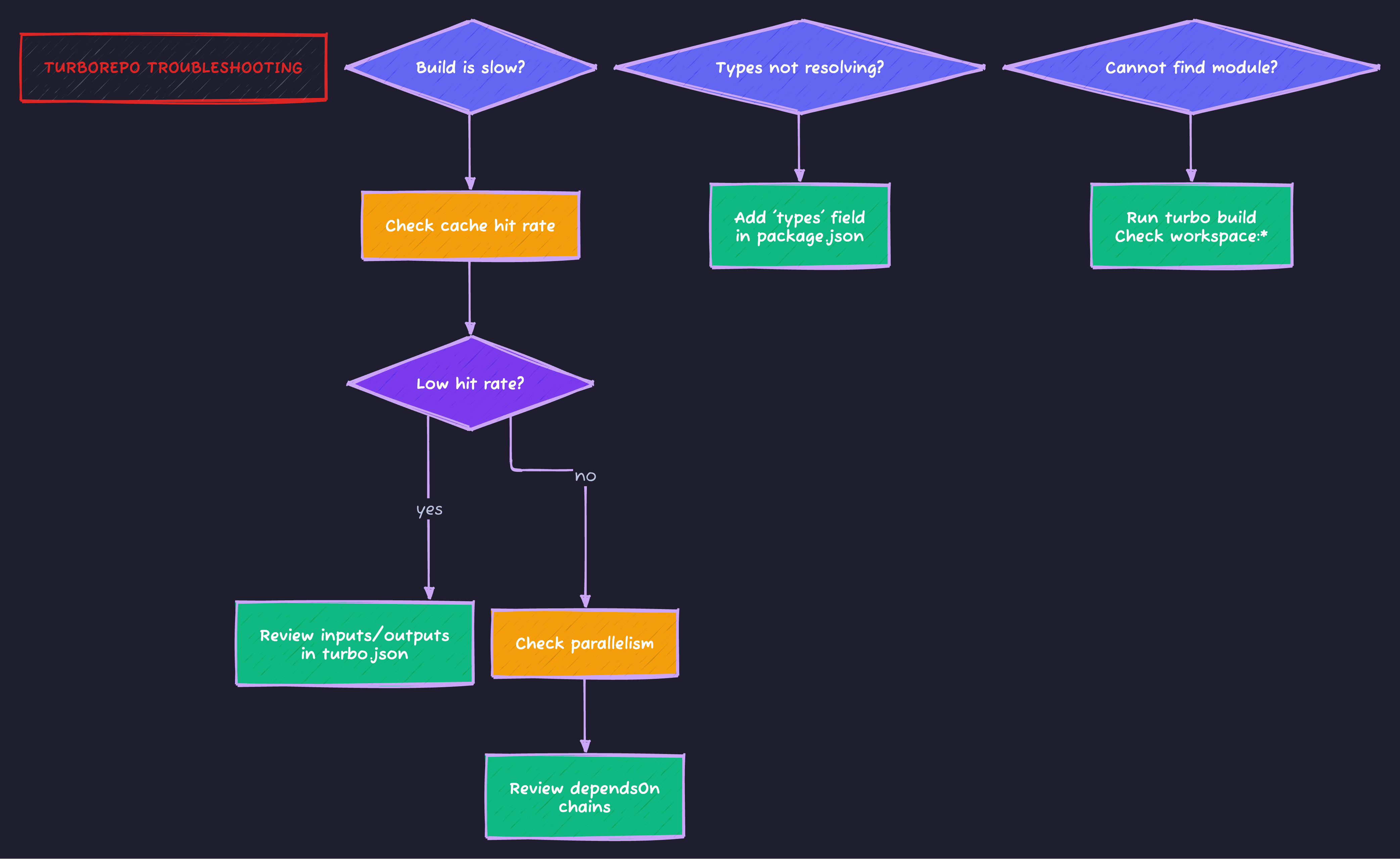
Solutions Table
| Problem | Cause | Solution |
|---|---|---|
| Cache never hits | Outputs not specified | Add "outputs": ["dist/**"] to turbo.json |
| Cache always misses | Env vars not declared | Add env vars to globalEnv or task env |
| Types not found | Missing declaration files | Ensure "declaration": true in tsconfig |
| Workspace package not found | Not in pnpm-workspace.yaml | Add path to workspace config |
| Build order wrong | Missing dependsOn | Add "^build" to dependsOn array |
| Dev server crashes | Circular dependency | Use --graph to identify cycles |
| Hot reload broken | Watch mode not configured | Add "persistent": true to dev task |
| Docker build slow | Not using turbo prune | Use multi-stage build with prune |
| CI timeout | No remote cache | Setup Vercel or self-hosted cache |
| Duplicate dependencies | No pnpm catalogs | Use catalog: for shared versions |
Debug Commands
# Visualize task dependencies
turbo run build --graph

# Check what will run
turbo run build --dry-run

# See cache status
turbo run build --summarize

# Force rebuild (ignore cache)
turbo run build --force

# Run with verbose output
turbo run build --verbosity=2

# See what files are inputs
turbo run build --dry-run=json | jq '.packages[].inputs'
Performance Benchmarks
Real benchmarks from a 10-package monorepo:
| Scenario | Without Turbo | With Turbo | Improvement |
|---|---|---|---|
| Full build (cold) | 4m 32s | 4m 28s | ~1% |
| Full build (local cache) | 4m 32s | 8s | 97% |
| Single package change | 4m 32s | 45s | 83% |
| CI with remote cache | 4m 32s | 12s | 96% |
| Lint (all packages) | 2m 15s | 35s | 74% |
| Typecheck (incremental) | 1m 45s | 15s | 86% |
Cache Size Management
# Check local cache size
du -sh .turbo/cache

# Clear local cache
turbo daemon clean

# Prune old cache entries (keep last 7 days)
find .turbo/cache -type f -mtime +7 -delete
Summary
| Pattern | When to Use |
|---|---|
| pnpm catalogs | Sync versions across all packages |
| workspace:* | Reference internal packages |
| turbo prune | Docker builds with minimal context |
| —filter=[HEAD^1] | CI runs on changed packages only |
| Remote cache | Team collaboration, faster CI |
| Changesets | Publishing packages with changelogs |
| Matrix builds | Parallel CI for multiple apps |
| Project references | TypeScript-aware dependencies |
Essential Commands
# Development
pnpm dev                              # Start all dev servers
pnpm turbo run dev --filter=web       # Start specific app

# Building
pnpm build                            # Build all
pnpm turbo run build --filter=web...  # Build app + deps

# Testing
pnpm test                             # Test all
pnpm turbo run test --filter='...[HEAD^1]'  # Test changed

# CI
pnpm turbo run build lint test --filter='...[origin/main]'

# Maintenance
pnpm turbo run clean                  # Clean all
turbo daemon clean                    # Clear cache
Turborepo transforms monorepo development from painful to productive. Start with the basics, add caching, then optimize incrementally based on your bottlenecks.
Advertisement
Moshiour Rahman
Software Architect & AI Engineer
Enterprise software architect with deep expertise in financial systems, distributed architecture, and AI-powered applications. Building large-scale systems at Fortune 500 companies. Specializing in LLM orchestration, multi-agent systems, and cloud-native solutions. I share battle-tested patterns from real enterprise projects.
Related Articles
Turborepo: High-Performance Monorepo Build System
Master Turborepo for monorepo management. Learn workspace setup, caching, pipelines, and build performant multi-package JavaScript projects.
JavaScriptNext.js 14 Tutorial: Complete Guide with App Router
Master Next.js 14 with App Router. Learn server components, data fetching, routing, server actions, and build full-stack React applications.
JavaScriptBuild a Dynamic OG Image Generator for Your Blog (Next.js + Screenshot API)
Stop manually creating social preview images. Learn how to automatically generate unique Open Graph images for every blog post using Next.js and a screenshot API.
Comments
Comments are powered by GitHub Discussions.
Configure Giscus at giscus.app to enable comments.