The Iterator Design Pattern: Loop Abstraction
Master the Iterator Pattern in Java. Learn how to access elements of a collection sequentially without exposing its underlying representation.
Moshiour Rahman
Advertisement
The Problem: Exposing Internal Structure
Imagine you have a custom collection class:
class BookShelf {
    private Book[] books = new Book[100];
    private int count = 0;

    public Book getBook(int index) { return books[index]; }
    public int getCount() { return count; }
}
If a client wants to loop through all books, they must:
- Know it’s an array internally.
- Use indices:
for (int i = 0; i < shelf.getCount(); i++).
If you later change the internal storage to a LinkedList, all client code breaks.
The Solution: The Iterator Pattern
The Iterator Pattern provides a way to access the elements of an aggregate object sequentially without exposing its underlying representation.
Real-Life Analogy: TV Remote Channel Surfing 📺
- You don’t know how channels are stored (array? linked list? database?).
- You just press Next and Previous.
- The remote gives you a sequential way to browse without knowing the internals.
Visualizing the Pattern
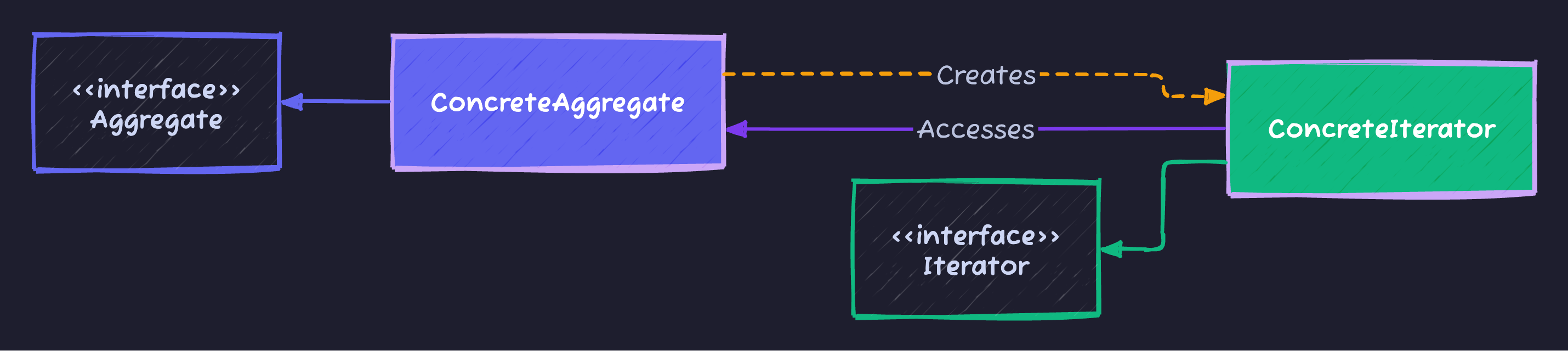
Implementation
1. The Iterator Interface
public interface Iterator<T> {
    boolean hasNext();
    T next();
}
2. The Aggregate Interface
public interface Aggregate<T> {
    Iterator<T> createIterator();
}
3. Concrete Aggregate
public class BookShelf implements Aggregate<Book> {
    private Book[] books = new Book[100];
    private int count = 0;

    public void addBook(Book book) {
        books[count++] = book;
    }

    @Override
    public Iterator<Book> createIterator() {
        return new BookShelfIterator(this);
    }

    // Package-private accessor for the iterator
    Book getBookAt(int index) {
        return books[index];
    }

    int getCount() {
        return count;
    }
}
4. Concrete Iterator
public class BookShelfIterator implements Iterator<Book> {
    private BookShelf shelf;
    private int index = 0;

    public BookShelfIterator(BookShelf shelf) {
        this.shelf = shelf;
    }

    @Override
    public boolean hasNext() {
        return index < shelf.getCount();
    }

    @Override
    public Book next() {
        return shelf.getBookAt(index++);
    }
}
Usage
BookShelf shelf = new BookShelf();
shelf.addBook(new Book("Design Patterns"));
shelf.addBook(new Book("Clean Code"));

Iterator<Book> it = shelf.createIterator();
while (it.hasNext()) {
    Book book = it.next();
    System.out.println(book.getTitle());
}
In The Wild (Real World Examples)
1. java.util.Iterator
Every Java collection implements the Iterator pattern!
List<String> list = Arrays.asList("A", "B", "C");
Iterator<String> it = list.iterator();
while (it.hasNext()) {
    System.out.println(it.next());
}
2. Enhanced For-Loop
The for-each loop is syntactic sugar for the Iterator pattern:
for (String s : list) { ... } // Uses iterator() under the hoodCheat Sheet
| Feature | Details |
|---|---|
| Category | Behavioral |
| Problem Solved | Sequential access without exposing structure |
| Key implementation | hasNext() and next() methods |
| Pros | Encapsulation (Hides internal collection structure) |
| Cons | Overhead (Creating an iterator object for simple cases can be overkill) |
Tips to Remember 🧠
- “Remote Control”: You control traversal without knowing what’s inside.
- “For-Each Magic”: Any class that implements
Iterable<T>can be used in a for-each loop.
Advertisement
Moshiour Rahman
Software Architect & AI Engineer
Enterprise software architect with deep expertise in financial systems, distributed architecture, and AI-powered applications. Building large-scale systems at Fortune 500 companies. Specializing in LLM orchestration, multi-agent systems, and cloud-native solutions. I share battle-tested patterns from real enterprise projects.
Related Articles
The Visitor Design Pattern: Add Operations Without Modifying Classes
Master the Visitor Pattern in Java. Learn how to add new operations to object structures using double dispatch.
JavaThe Template Method Pattern: The Recipe for Success
Master the Template Method Pattern in Java. Learn how to define the skeleton of an algorithm in a superclass but let subclasses override specific steps.
JavaThe Strategy Design Pattern: Kill the If-Else Statements
Master the Strategy Pattern in Java. Learn how to replace complex if-else logic with interchangeable algorithms and follow the Open/Closed Principle.
Comments
Comments are powered by GitHub Discussions.
Configure Giscus at giscus.app to enable comments.